
Cracking the “Code”
The Hanky Code, also known as "flagging," emerged in the 1970swithin gay subcultures in New York and San Francisco as a discreet way to signal sexual preferences in crowded bars and public spaces. By wearing a colored handkerchief in a specific back pocket men could communicate desires non-verbally, bypassing the need for explicit conversation in a climate where such expression was often criminalized or unsafe.
Many would regard flagging as a lost art with the evolution of modern technology.
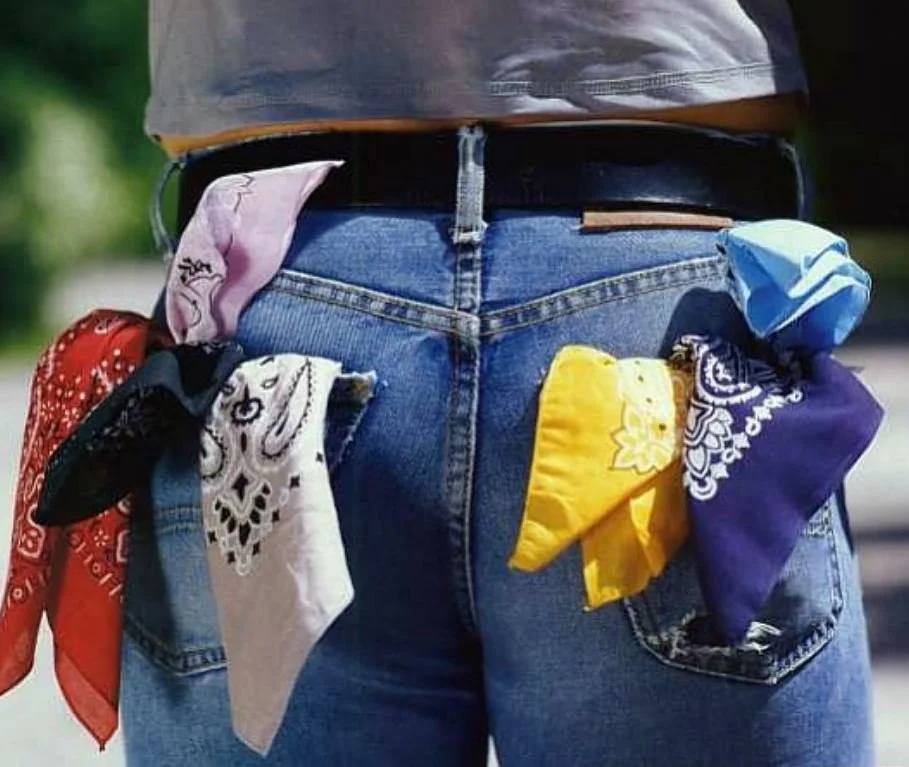
The birth of Queer Semiotics
Flagging is a major case study in queer semiotics—the study of how marginalized groups develop their own systems of signs and symbols to survive and thrive.
It proved that queer culture didn't need the "permission" of the mainstream to create complex, functional social structures.
Left, right, or both?

left (active)
The one doing the action
Right (Passive)
The one receiving the action

Most early practitioners and archival accounts suggest the initial code was limited to a small, functional set:
Black: S&M / Leather
Dark Blue: Anal Sex
Light Blue: Oral Sex
Red: Fisting
Yellow: Watersports
White: Masturbation (J/O
Although throughout the years, there have been a lot more added
color and material matter
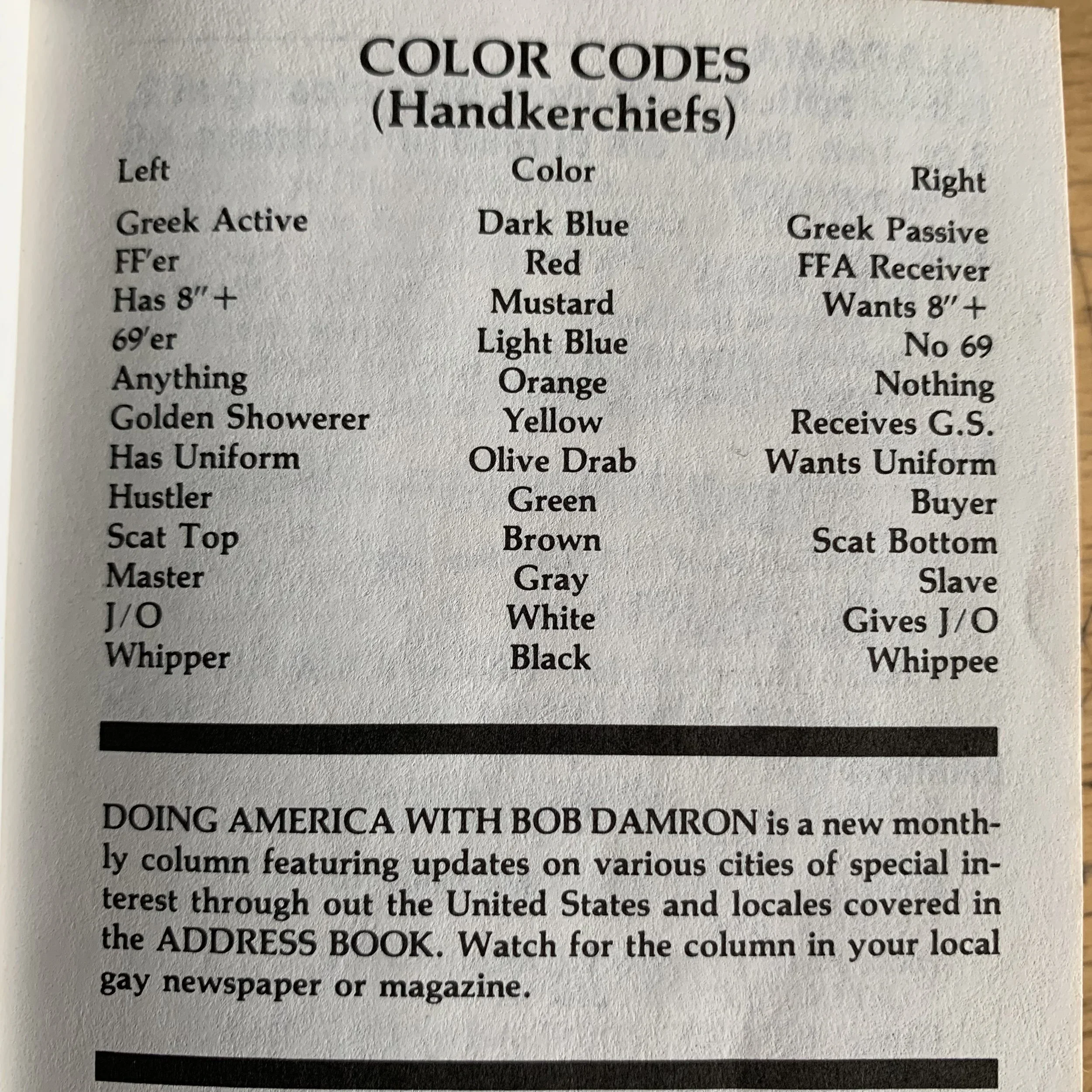
Evolution of Colors
Bob Damrons Address Book (1980)
Starting in 1964, a businessman by the name of Bob Damron published a book of all the gay bars he knew from his constant travels across the United States. “This book fit comfortably in the palm of your hand,” a description reads. “Despite its petite size, this book was an impressive accomplishment. Each one of the listings he had visited himself. Every last copy of the book he sold himself.”
The guides, called Bob Damron’s Address Book, featured various bars, bathhouses and “cruisy areas” in cities from all 50 states. Also listed in the guides was the handkerchief code.
Current commonly accepted color chart
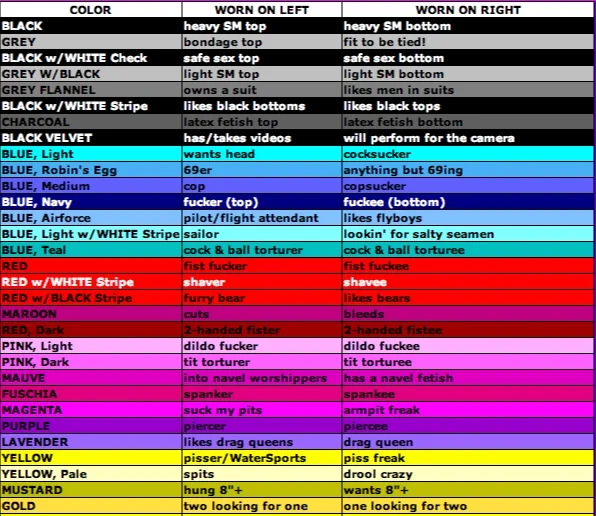
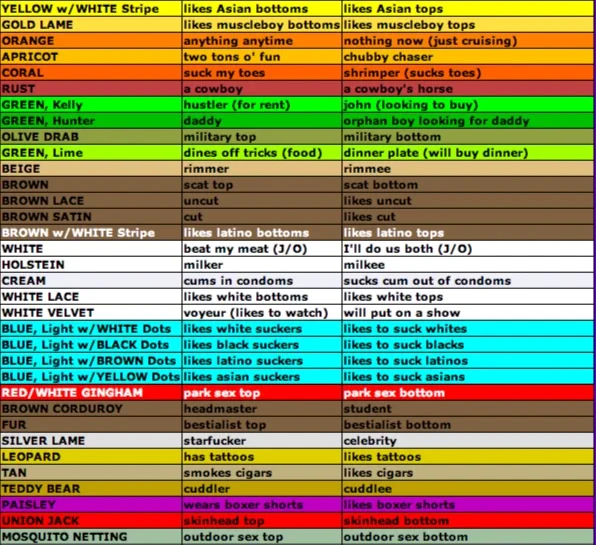

Navigating the Code in Modern Context
Generational and Sub-Cultural Divide
The "Historical" Perspective
(Traditional Gay Community):
For many who lived through the 1970s and 80s, the code is a functional tool. They often view it with a sense of historical weight, prioritizing its original utility as a safety and cruising mechanism. They tend to be more sensitive to "incorrect" usage, as they recall when a specific color could have life-altering social (or legal) consequences.
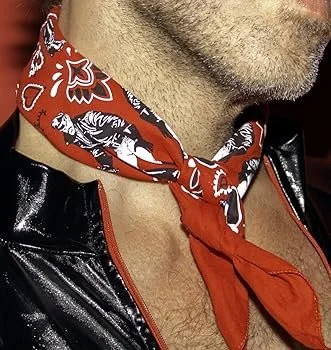
The "Aesthetic" Perspective:
(Younger Generations, Fashion & Furry Culture)
For younger people, fashion and members of the furry community, the hanky is often treated as an identity marker or aesthetic choice. Many adopt these symbols to signal belonging to a subculture or simply to match a color palette. The focus here is usually on community identity rather than specific, binding sexual intent.
Disclaimers and Dialogue:
The Hanky Code is a continued part of queer history. Meanings have shifted, evolved, and varied by region over the decades. Never assume a color is an active signal based on a static list—always use the hanky as an icebreaker, not a contract. Many modern leather and fetish clubs have shifted toward verbal communication and consent-first policies. The code is now treated more like an "icebreaker" or a nod to heritage rather than a binding contract of intent.
Treat the hanky as an icebreaker, not an instruction. Approach with respect, introduce yourself, and ask: "I noticed you’re wearing a [color] hanky—is that intended as a signal, or is it just for style?" A quick, verbal check-in protects both parties, honors the history of the practice, and ensures that everyone is on the same page.
how to approach
More Resources
The information compiled in this document only begins to dive into Queer History and the Evolution of Leather, Kink and Subculture. This document is intended for educational purposes.
Foundational Texts & Archives
The Leather Archives & Museum (LA&M). Flagging: A History. leatherarchives.org (Digital and physical repository for historical subculture symbols).
The GLBT Historical Society. Online Exhibits: Queer Signaling & Semiotics. glbthistory.org
Fischer, Hal. (1977). Gay Semiotics. NFS Press. (The seminal photographic study of flagging in 1970s San Francisco).
Levine, Martin P. (1979). Gay Macho: The Life and Death of the Homosexual Clone. NYU Press. (Sociological context on the development of queer identity and signaling).
Townsend, Larry. (1983). The Leatherman's Handbook II. (A definitive guide to BDSM etiquette and early flagging practices).
Modern Context & Video Media:
Watts the Safeword. The Hanky Code: What It Is & How It Works. YouTube: Watts the Safeword (A modern, clear breakdown of flagging etiquette, consent, and its role in contemporary fetish scenes).
Prestage, G., et al. (2009). "The Role of Flagging in Contemporary Queer Nightlife." Journal of Homosexuality. (Academic analysis of how digital communication has shifted the function of physical flagging).
Untucking Queer History: OUT Magazine: https://www.out.com/out-exclusives/2017/6/19/untucking-queer-history-colorful-hanky-code
The Handkerchief Code: https://www.thesaintfoundation.org/community/hanky-code-bob-damrons-address-book
Wikipedia: Hanky Code: https://en.wikipedia.org/wiki/Handkerchief_code
For any additional comments or questions, please reach out to your local Leather/Kink Community or feel free to reach out below
This information was compiled and designed by:
Excelsior Alpha
Recon: BlondeAlpha1
BLSKY/TWT